 LUDO ZAP
How to Play Ludo: Rules, Setup and Winning Tips
Updated
Ludo is a race for 2 to 4 players: roll the die, move your four tokens around the board and bring them all home first. It grew out of the Indian game Pachisi and takes minutes to learn. Here are the classic rules, popular house rules, winning tips and how Ludo Zap plays it online.
The Ludo board and pieces
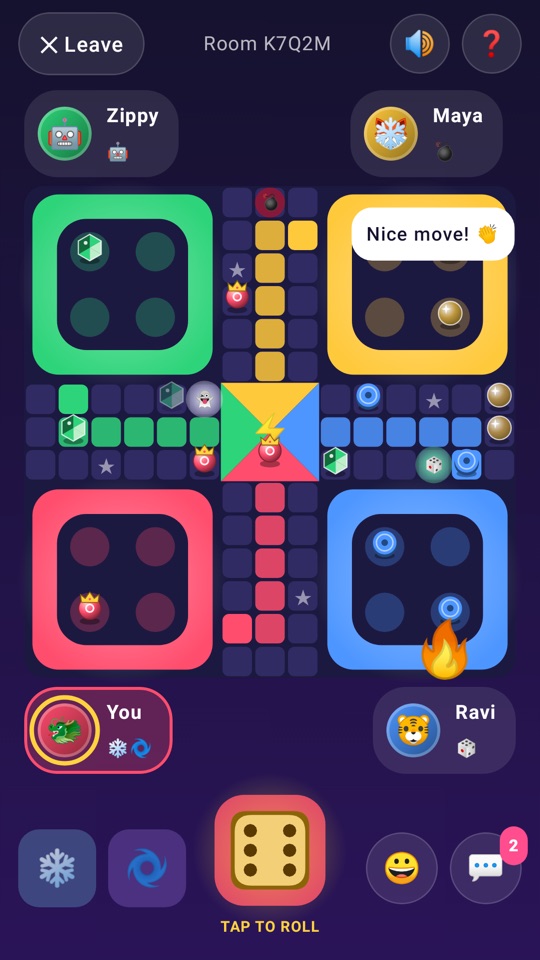
A Ludo board is a square with a cross-shaped track. Each corner has a colored yard, usually red, green, yellow and blue, holding that player's four tokens. Everyone shares one six-sided die.
- Main track: 52 squares around the arms of the cross. Tokens move along it in one direction, usually clockwise.
- Start square: the colored square next to each yard, where that color's tokens enter the track.
- Home column: five squares in your color leading to the center. Only your tokens may enter it.
- Home: your colored triangle in the center, where finished tokens rest.
- Safe squares: many boards mark stars, and often the start squares, where tokens can't be captured.
Setting up a game
Each player picks a color and puts four tokens in the matching yard. With two players, take opposite corners. Everyone rolls the die and the highest roll goes first, then play passes clockwise.
Taking a turn
- Roll the die.
- Roll a 6 to move a token out of your yard onto your start square.
- Otherwise, move one token on the track forward by the number you rolled. A roll can't be split between tokens.
- After a 6, move and then roll again.
- If none of your tokens can move, your turn passes.
A 6 comes up once every six rolls on average, so the first few turns are often spent waiting to leave the yard.
Capturing and safe squares
End your move exactly on a square holding an opponent's token to capture it: that token goes back to its yard and needs another 6 to come out. Passing over a token does nothing. Many rule sets also give a bonus roll for a capture.
A token on a safe square can't be captured, so several colors may share it. Safe squares vary by board; stars and start squares are the most common.
The home column and winning
After nearly a full lap, each token turns into its own home column. Opponents can't follow it there, so it's safe. To finish, you need the exact number to reach the center; if your roll is too high, move another token instead.
The first player to bring all four tokens home wins. In bigger games the others can play on for second and third place.
Common house rules and variations
Ludo has no single official rulebook, so agree on these before you start:
- Three sixes: rolling three 6s in a row ends your turn.
- Blockades: two tokens of the same color on one square form a wall that opponents can't pass or capture.
- Capture before home: many Indian versions require a capture before any of your tokens may enter the home column.
- Bounce back: a token that overshoots the center moves back by the extra squares instead of waiting for an exact roll.
- Fast start: everyone begins with one token already out, or tokens may also leave the yard on a 1.
- Teams: with four players, opposite corners play as partners and win together.
Ludo strategy tips that win games
- Get tokens out early. More tokens on the board means more options for every roll: to capture, to dodge or to reach a safe square.
- Count the squares behind you. An opponent 1 to 6 squares behind can hit you with one roll, about a 1 in 6 chance. From 7 to 12 squares away they need a 6 first, which cuts the risk to about 1 in 36.
- Mind the exits. The six squares after an opponent's start square are risky: a token that comes out on a 6 gets another roll straight away.
- Capture tokens that have traveled far. Sending back a token near its home column costs your opponent dozens of squares.
- Don't race one token alone. Spread your moves so a single capture can't ruin your game, and hop between safe squares when you can.
Ludo Zap rules and twists
Ludo Zap, a free online Ludo game for Android, follows the classic rules with these settings:
- 2 to 4 players, online, against bots or with friends in a private room. Two-player games use opposite corners. A random player starts and turns pass clockwise. The board turns so your yard is always bottom left.
- Sixes and extra rolls. A 6 brings a token out onto your start square. A 6, a capture or a token reaching home earns another roll, with no three-sixes penalty.
- Eight safe squares: the four start squares and four ★ stars, safe for every color, even a rival parked on your start square.
- No blockades. Doubled-up tokens don't block anyone, and landing on a square with two or more rival tokens sends all of them back.
- Exact finish. The home column has five squares and you need the exact roll to reach the center. Tokens in the home column can't be captured.
- Power-ups. Stop on one of the four glowing orbs to collect its power (hold up to two) and use it before you roll. See the Ludo power-ups guide.
- 15-second turns. If you don't roll or pick a token in time, the game plays that step for you.
- One winner. The first player to bring all four tokens home wins and the match ends.
Ludo rules FAQ
Do you need a 6 to start in Ludo?
In the classic rules, yes: a token can only leave the yard on a 6. Some house rules also allow a 1. Ludo Zap always needs a 6, though Lucky Dice lets you choose one.
Can you capture a token on a safe square?
No. Tokens on a safe square can't be captured, so several colors can share it. In Ludo Zap that means the four start squares and the four stars.
What happens if you roll three 6s in a row?
It depends on your rules. A popular house rule ends your turn after the third 6. Ludo Zap has no limit: every 6 earns another roll.
Do you need an exact roll to get home in Ludo?
In most versions, yes: if the roll is higher than the squares left, that token can't move. Ludo Zap uses this exact-roll rule.
Play Ludo online, free
Online matches, private rooms for friends and five power-ups. No ads, no sign-up.